

Hello Everyone,
I hope you’ve had a good weekend so far, with plenty of rest. I didn’t send out the recording of Friday’s live till today so I could take advantage of the first big snow of the season with my family. We’ve been sledding in our yard, made cranberry orange muffins, and watched some of our favorite movies.
The Cultivar Chat was excellent, a huge thank you to everyone who attended! It’s always a privilege to talk with you and get your insights and perspectives on the themes we discuss.
This past week, the focus was on the difference between the Greek understanding of time through chronos and kairos, or sequential and impactful measurement. I’m coming across an increasing number of people who are either intentionally leaving behind sequential understandings of growth, progress, and success, or shifting out of that mindset for survival.

I mentioned recently that the polycrisis we are facing globally is in fact a singular crisis of leadership, yet over the past few days I’ve been thinking a bit deeper on it.
Since the relational, animistic lens of leadership views itself as a stance, rather than a role, then the crisis is, in fact, one of relation. To time, knowledge, action, understanding, Self, Collective, and World.
Rooted in kairos, that stance becomes a practice of discernment, of pattern stewardship, and of intentional engagement.
The accumulation of minutes, months, and years understood in the West as how to measure growth and progress has separated and enclosured us from the felt, reciprocal complexity of kairos time.
There is a shift across humanity, a mass pivot, simultaneously quiet and loud, in what many are accepting as truth. People are choosing to reorient their understanding of time toward experiencing through impact rather than sequence.
It is a response to a collective feeling of unnaturalness, of out-of-relationness to our world, that has reached such a point due to the accumulation of knowledge and its flattening into simplistic understanding and manipulation. There is a loss of complexity that we feel but can’t explain.
“The war between good and evil is in reality an imposition of stupidity and simplicity over wisdom and complexity.”
Tyson Yunkaporta, Sand Talk
So much of our time and attention is taken away from the biological functions that allow us to fully experience and remember our past and present, which informs the paths we take for the future.
Many of us intake so much these days and yet don’t act on it. Sometimes by choice, sometimes by manipulation, we stagnate while enmeshed to an entity that never stops moving in an attempt to never die; an unnatural function of nature that cannot be equated to decay. Decay and death are meant to be a part of the cycle that generates new and emergent life.

This collective shift is a seismic ripple of the many small actions of people who are trying to re-enter time through impact. We’re remembering in our nervous systems, in our bones, in our dreams that time and place were never meant to be split from each other, let along meaning, story, and identity.
This is not just a poetic or philosophical idea: in many Indigenous languages, there is no separation between them:
”You talk about time and place … As you said, there’s no distinction there between those terms in your language—obviously in English there is, and maybe that distinction is part of this challenge?”
Emmanuel Vaughan-Lee, Deep Time Diligence: An Interview with Tyson Yunkaporta. Emergence Magazine
To envision a better future for oneself or humanity, we cannot continue to view “progress” as a linear sequence of events and milestones. Our dreams must be felt, not managed.
They are meant to be lived, instead of being accumulated and enmeshed to the systemic needs of society. The disconnect that progress-management has fostered in us has given us blueprints for a life we will never be able to build.
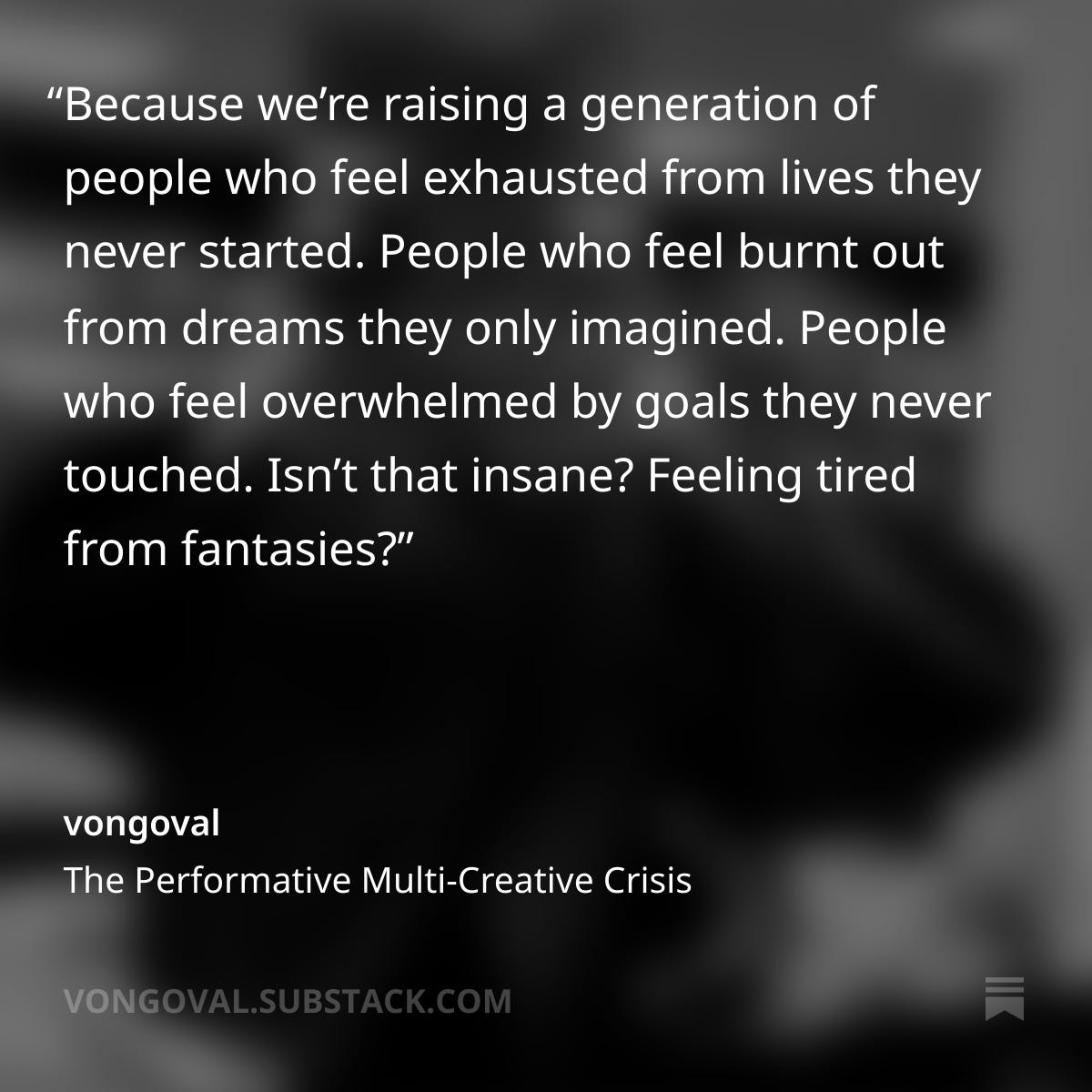
It’s almost a visceral hunger, incrementally grown from being enclosed out of a world of meaning and fed a diet built on productivity metrics and development. A world where time and place aren’t separate, and the pace of life aligns with memory, attention, vision, landscape, and kinship. A world that we are still part of but haven’t been in relation with on a global scale for centuries.
It is possible to return to right relation with time and impact. We just have to choose to do so, a lesson that repeats in its applicability.
When one knows something but has not yet acted on it, his knowledge is shallow.... Knowledge and practice always require each other. With respect to order, knowledge comes first, and with respect to importance, practice is more important.
Zhu Xi, 1130-1200
Those who are shifting towards a different worldview are choosing kairos over chronos because it flows through meaning, which requires us to be in motion with the world, not apart from it.
The inherent binaries of good and evil, true and false, fast and slow are a systemic violence against the complexity of life. The suffering that process has caused is finally reaching a zenith.
We cannot chart a new course forward with the tools that disconnected us in the first place. But maybe it isn’t about a course forward towards the future, but rather expanding in all dimensions, to include what Grace Aimoto explains as interiority.
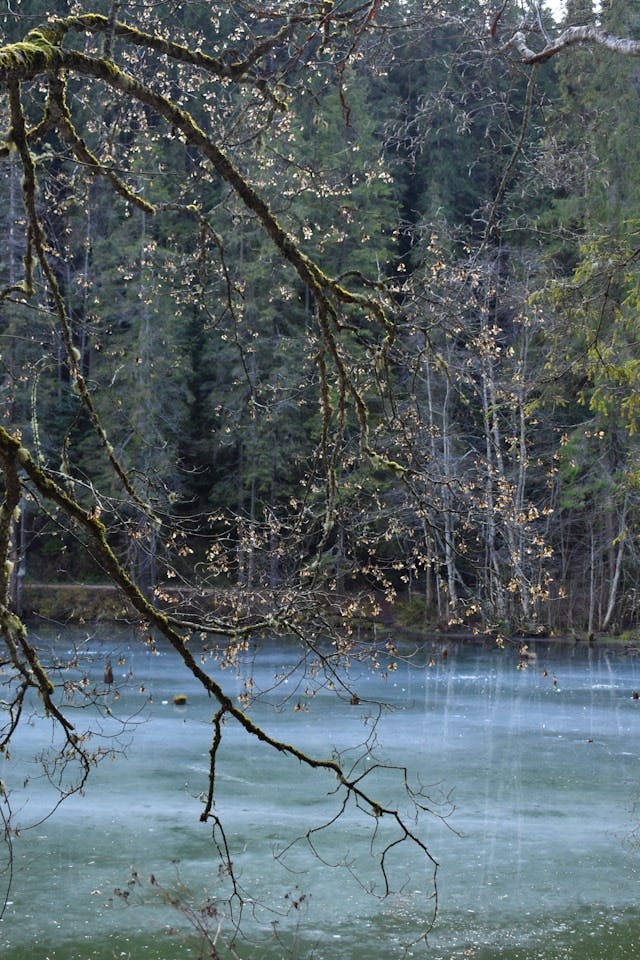
Trees grow in concentric rings, not in straight lines. Each ring holds memory, climate, conditions; a record of Kairos that tells us the depth of the ecosystem’s story far better than simply counting the number of rings for the chronological record.
Leadership can be imagined the same way, concentric and related acts of relation rooted to place and memory.
So let us as leaders shift from measuring time, to participating in it.
Let us feel the weight of our humanity, and bear it together.
Let us embrace this return to right relation rather than fear its enormity.
If you had rings like a tree, what would they say about how you have lived your live thus far, and how you’ve led?
Until next time,
Chris
Welcome, and thank you for your presence!
I am a leadership ecologist rooted in Appalachia, raised through environmental respect, military service and Western educational institutions. I use an animistic lens to better understand the relationship between individuals, organizations, and systems.
When working with leaders and organizations, my approach not one of doctrine, but of guidance and tending to: to memory, to culture, to systems and people. I believe leadership is not a fixed role, but a living, relational practice.
My work draws from my lived experience and research into myth-making, insurgency and business strategies, regenerative philosophies, creative works, the landscape I inhabit, and the mundane, because the ember of humanity is often nurtured in and between those spaces.
If something resonates, leave a comment, or reach out to chat - I always love hearing people’s stories.
You are always welcome to book a free call to either get fresh perspective or see if we’d work well together in cultivating your capacity to lead.
I offer a variety of services, 1:1 coaching, group programs, leadership training development, and culture consultation.